
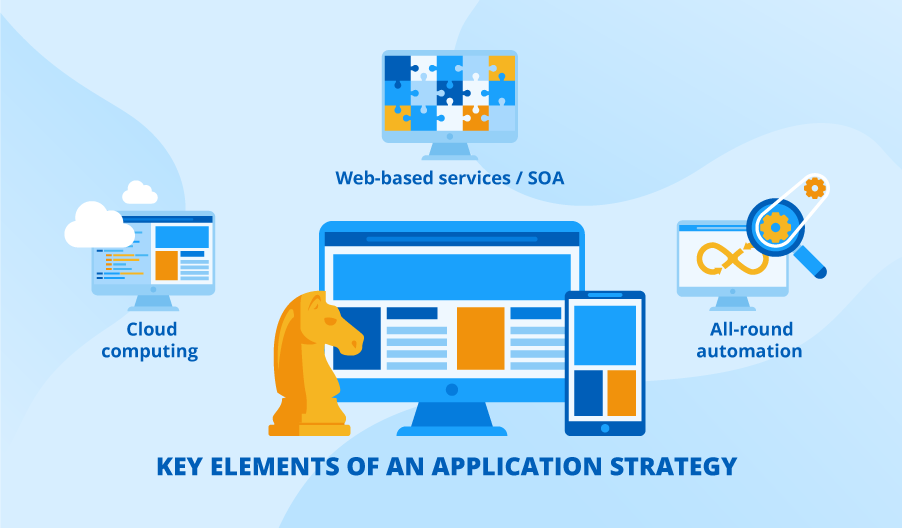
In today’s fast-evolving digital landscape, enterprise applications are more than just tools for operations—they are the backbone of innovation, competitive advantage, and customer experience. Organizations that strategically manage and modernize their application ecosystem can drive agility, optimize performance, and accelerate growth. This article dives deep into advanced application strategies for modern enterprises—going beyond beginner or generic topics—and explores how applications can be transformed into engines of continuous business value.
1. Strategic Alignment Between Business Goals and Applications
The Role of Business-Driven Applications
Applications should not exist in isolation; they must serve as direct enablers of business outcomes. When technology and business strategy are aligned, every application becomes a measurable contributor to efficiency, revenue, and customer satisfaction.
How to Achieve Alignment
-
Comprehensive Application Mapping: Start by cataloging every application within your ecosystem. Identify its purpose, users, integration points, and the business process it supports.
-
Value-Based Prioritization: Classify applications according to their contribution to strategic goals. Prioritize modernization or investment in those driving core business processes.
-
Outcome-Oriented KPIs: Move from IT-centric metrics like uptime to business metrics such as process automation rates, revenue per transaction, or time-to-market improvements.
-
Continuous Feedback Loops: Engage business stakeholders regularly to ensure that evolving requirements are reflected in the application roadmap.
Common Mistakes to Avoid
Many enterprises make the mistake of viewing applications as standalone projects rather than strategic platforms. The result is redundancy, rising maintenance costs, and missed innovation opportunities. A successful application strategy demands business-first thinking and constant reevaluation of purpose and impact.
2. Intelligent Application Modernization
Moving Beyond Lift-and-Shift
Traditional “lift and shift” cloud migrations—simply moving legacy systems to new infrastructure—are no longer sufficient. Modernization today involves refactoring, rearchitecting, and rebuilding applications to fully exploit cloud-native capabilities like scalability, elasticity, and real-time analytics.
The Advanced Modernization Framework
There are multiple modernization strategies enterprises can adopt depending on application complexity and business needs:
-
Rehost: Quickly migrate applications to the cloud without changing core architecture.
-
Replatform: Optimize applications slightly during migration to leverage cloud benefits such as containerization.
-
Refactor: Modify the codebase to improve scalability, performance, and maintainability.
-
Rearchitect: Redesign legacy monoliths into microservices or serverless structures.
-
Rebuild: Recreate the application from scratch with modern technology stacks.
-
Replace: Retire outdated systems and adopt commercial SaaS solutions.
Key Considerations
When modernizing, organizations must balance speed, cost, and complexity. Over-engineering can delay results, while underinvestment limits future scalability. The most successful modernization programs are iterative, starting small and expanding gradually as business benefits are realized.
3. Application Integration for a Connected Enterprise
The Integration Imperative
In fragmented IT ecosystems, disconnected applications hinder data flow and create silos. Modern enterprises require seamless integration to ensure real-time data visibility, process automation, and consistent user experiences.
Integration Approaches
-
API-Led Connectivity: APIs act as reusable building blocks that connect systems and services efficiently.
-
Event-Driven Architecture: Enables applications to respond in real time to events, ensuring agility and adaptability.
-
iPaaS (Integration Platform as a Service): Provides scalable cloud-based integration with prebuilt connectors and orchestration tools.
-
Data Virtualization: Allows unified data access across disparate systems without physically moving it.
Benefits of Strong Integration
Integrated applications reduce redundancy, accelerate decision-making, and improve agility across departments. With APIs and automation frameworks, enterprises can innovate faster while maintaining control over security and compliance.
4. Leveraging AI and Automation in Application Ecosystems
From Reactive to Predictive Applications
Modern applications must evolve from reactive systems to intelligent ecosystems that predict user needs, automate workflows, and deliver insights proactively. Artificial Intelligence (AI), Machine Learning (ML), and Robotic Process Automation (RPA) are revolutionizing how applications perform and interact with data.
Key AI-Driven Capabilities
-
Predictive Analytics: Identifies patterns to forecast outcomes such as customer behavior or equipment failure.
-
Cognitive Automation: Uses AI to handle unstructured data like documents or emails.
-
Adaptive Interfaces: Personalizes user experiences based on behavioral data.
-
Self-Healing Systems: Detect and resolve performance or security issues automatically.
Enterprise Impact
Integrating AI and automation within applications enhances efficiency, reduces manual intervention, and improves reliability. As enterprises mature, intelligent applications become a competitive differentiator—turning data into strategic foresight.
5. Application Security and Compliance
The New Security Paradigm
With the rise of hybrid and multi-cloud environments, application security must extend beyond the perimeter. Modern security frameworks adopt a Zero Trust approach, ensuring every access request is verified, regardless of origin.
Advanced Security Measures
-
Identity and Access Management (IAM): Controls who can access applications and data.
-
Application Security Testing (AST): Includes static, dynamic, and interactive testing to uncover vulnerabilities.
-
Runtime Protection: Monitors applications in real time for suspicious behavior.
-
Encryption and Tokenization: Safeguards sensitive data across transit and storage.
Compliance as a Competitive Advantage
Rather than viewing compliance as a regulatory burden, leading organizations integrate it into their application lifecycle. Embedding compliance frameworks (GDPR, HIPAA, SOC 2) from the design stage not only mitigates risk but also builds customer trust.
6. Performance Optimization Through Observability
Moving from Monitoring to Observability
Traditional monitoring checks if applications are “up.” Observability goes deeper—it explains why issues occur by analyzing metrics, logs, and traces collectively.
Core Observability Pillars
-
Metrics: Quantitative indicators like latency, throughput, and error rates.
-
Logs: Event records for understanding system behavior.
-
Traces: Track a request’s journey across distributed systems to identify bottlenecks.
Business Benefits
Advanced observability frameworks provide predictive insights into performance trends, helping enterprises prevent outages before they occur. This proactive stance minimizes downtime, enhances user satisfaction, and drives operational excellence.
7. Continuous Delivery and Application Lifecycle Automation
Embracing Continuous Everything
Continuous Integration (CI), Continuous Deployment (CD), and Continuous Testing are the cornerstones of high-performing DevOps organizations. Automated pipelines ensure code moves rapidly from development to production with minimal risk.
Strategic Advantages
-
Reduced Release Cycles: Faster delivery of new features and fixes.
-
Improved Quality: Automated testing ensures consistency and reliability.
-
Business Agility: Teams respond quickly to market shifts without compromising stability.
Building a Culture of Continuous Improvement
The real value of automation lies not just in technology but in culture. Encouraging collaboration, experimentation, and feedback loops across teams fosters innovation and long-term sustainability.
Conclusion
Modern application strategy is not about building more—it’s about building smarter. By aligning technology with business value, integrating AI and automation, ensuring continuous modernization, and embedding security at every layer, enterprises can transform their application ecosystems into powerful strategic assets. The organizations that master this transformation will not just keep pace with change—they will define it.
FAQs
1. What is the main difference between application modernization and digital transformation?
Application modernization focuses on updating technology stacks, architectures, and performance, while digital transformation encompasses the broader organizational shift involving culture, processes, and business models.
2. How do microservices improve enterprise application performance?
Microservices enable modular development, independent scaling, and faster deployments, leading to improved agility, fault isolation, and overall application resilience.
3. What are the biggest challenges in modernizing legacy applications?
Key challenges include data migration, technical debt, lack of documentation, integration complexity, and aligning modernization pace with business continuity.
4. Why is observability more important than traditional monitoring?
Observability provides deeper contextual insights, allowing teams to understand system behavior, detect anomalies proactively, and optimize performance in real time.
5. How can AI enhance application lifecycle management?
AI supports predictive analytics for performance, automates testing, and enables self-healing systems that minimize downtime and manual intervention.
6. What role does DevOps play in enterprise application strategy?
DevOps bridges the gap between development and operations, ensuring continuous delivery, rapid feedback, and efficient collaboration across teams.
7. How can enterprises measure the success of their application modernization efforts?
Success metrics include improved system uptime, faster release cycles, enhanced user experience, reduced technical debt, and measurable business outcomes such as cost savings or increased revenue.
