
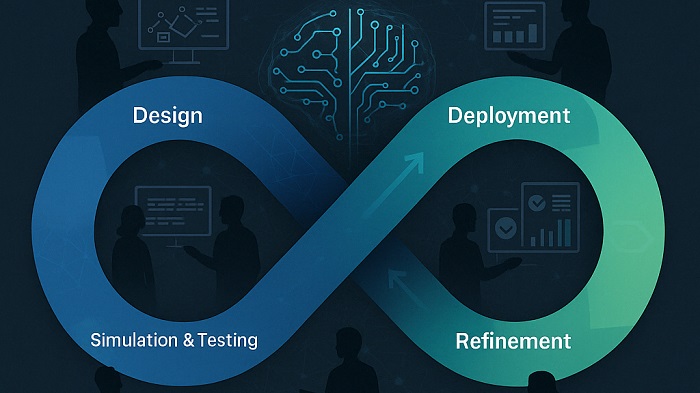
In today’s AI-driven environment, software is no longer a collection of static modules or services—it’s an intelligent, adaptive ecosystem. Traditional architectural blueprints such as layered systems or microservices, while effective in the past, can’t fully accommodate the growing complexity and autonomy demanded by modern software. The future belongs to architectures built around intelligence, context-awareness, and continuous evolution. Below, we explore how forward-looking engineers and architects are redefining the boundaries of software design in the AI-first age.
1. Agentic AI as a First-Class Architectural Component
The paradigm shift toward autonomy
Software systems are moving beyond rule-based logic to incorporate agentic AI—autonomous entities capable of planning, acting, and learning from their environment. Each agent functions as a self-contained unit, empowered to interpret high-level goals and coordinate with other agents to achieve them. This redefines modularity, requiring systems to support emergent, adaptive, and goal-oriented behavior.
Key architectural principles
-
Bounded autonomy: Every agent must have clearly defined authority and limits to ensure its decisions align with broader system objectives.
-
Intelligent communication: Instead of simple API calls, agents use structured messaging, semantic protocols, and shared context to collaborate.
-
Self-orchestration: Agents can dynamically allocate responsibilities, prioritize tasks, and resolve conflicts without explicit orchestration scripts.
-
Explainability and trust: Observability frameworks should include traceable decision logs, fairness audits, and ethical constraints.
-
Evolution readiness: Architectures must accommodate continuous learning loops, allowing agents to update themselves based on performance metrics.
Agentic AI represents a new layer in software architecture—one where systems no longer just “execute” but “reason.” Building such systems requires rethinking concurrency, control, and governance at scale.
2. Platform Engineering: Software Built for Developers
Beyond DevOps and Infrastructure as Code
As software ecosystems grow more complex, developers struggle to manage pipelines, environments, and deployment processes. Platform engineering addresses this by treating the development platform itself as a product—complete with APIs, service abstractions, and user experience considerations. Internal Developer Platforms (IDPs) are designed to streamline development, automate infrastructure, and enforce governance seamlessly.
Core architectural elements
-
Composable infrastructure: Build modular, reusable components (pipelines, build environments, monitoring stacks) that can be versioned and deployed like microservices.
-
Abstraction and usability: Developers interact with high-level APIs instead of directly managing Kubernetes, Terraform, or serverless functions.
-
Security and compliance baked-in: Policies, permissions, and audit trails are embedded into the platform itself rather than added later.
-
Telemetry and feedback loops: The platform should measure developer experience—build times, error rates, environment drift—and adapt to minimize friction.
-
Ecosystem integration: Integrate with authentication systems, feature flags, secrets managers, and observability stacks to create an end-to-end developer experience.
A well-architected platform doesn’t just improve efficiency—it creates leverage. By abstracting repetitive infrastructure concerns, platform engineering allows developers to focus on business logic, not operational details.
3. Data-Centric Architecture and the Rise of Semantic Layers
Shifting from application-centric to data-centric systems
Modern software isn’t defined by what it does but by what data it owns, processes, and understands. Data-centric architecture treats data as the primary asset, independent of applications. This approach supports scalability, interoperability, and analytics across domains, a necessity for AI-first organizations.
Core design philosophies
-
Domain data ownership: Each business domain manages its own data as a “data product,” complete with APIs, documentation, and lifecycle ownership.
-
Semantic layers: Instead of direct database queries, applications interact with semantic abstractions that define meaning and relationships across data sets.
-
Zero-copy architecture: Data is processed in place through APIs and streaming layers rather than being duplicated across systems.
-
Metadata-first design: Systems automatically document data lineage, transformations, and governance policies.
-
AI-readiness: Data pipelines should support both analytical and operational AI workloads, minimizing preprocessing redundancy.
This design philosophy enables organizations to unify analytics, AI, and application logic under a single consistent data model—fueling both operational efficiency and machine intelligence.
4. Continuous Architecture: Evolving Systems Without Stagnation
Architecture as a living organism
Traditional architecture often treats design as a static milestone. In contrast, continuous architecture embraces the idea that systems evolve constantly in response to feedback, usage, and new technologies. It is a mindset shift—architecture as an ongoing, measurable process rather than a one-time design exercise.
Essential practices
-
Architectural fitness functions: Define measurable goals for qualities such as latency, scalability, and maintainability.
-
Automated validation: Use CI/CD pipelines to test not only code but also architecture compliance with defined standards.
-
Incremental evolution: Implement changes through small, reversible experiments to avoid disruptive overhauls.
-
Observability-driven improvement: Use runtime metrics to inform design refinements continuously.
-
Cross-functional collaboration: Architects must collaborate closely with operations, product, and AI teams to align technical direction with strategic goals.
Continuous architecture ensures that systems remain relevant and performant even as technology stacks and business models evolve.
5. Edge Intelligence and Distributed Decision-Making
The shift toward distributed intelligence
As latency and privacy become critical, the architectural focus is moving closer to the data source. Edge intelligence combines local computation, lightweight AI inference, and adaptive communication models. It empowers devices and nodes to act semi-autonomously, reducing cloud dependency and enabling real-time responsiveness.
Architectural considerations
-
Hybrid cloud-edge orchestration: Seamlessly balance computation between central servers and distributed nodes.
-
Model compression and deployment: Optimize AI models to run efficiently on constrained edge hardware.
-
Federated learning: Train models collaboratively across devices without centralizing sensitive data.
-
Resilience and synchronization: Ensure consistency between edge nodes and the central system through conflict-free data replication.
-
Security at the edge: Implement zero-trust security models with identity verification, encryption, and threat detection baked in.
Edge intelligence marks the convergence of AI, networking, and software design—creating architectures that are fast, secure, and contextually aware.
6. Software Observability in Complex Adaptive Systems
Observability beyond monitoring
Monitoring tells you that something is wrong. Observability tells you why. In AI-first and distributed systems, observability becomes a design requirement rather than an afterthought. It provides visibility into complex interactions between microservices, agents, and data pipelines.
Core observability strategies
-
Unified telemetry: Collect logs, metrics, and traces from all components into a centralized knowledge graph.
-
Context propagation: Use correlation IDs to trace a single transaction through distributed layers.
-
Anomaly detection and self-healing: Integrate AI-driven diagnostics to identify patterns and trigger corrective actions automatically.
-
User-centric insights: Measure real-world outcomes such as performance impact, feature adoption, and reliability from an end-user perspective.
-
Feedback integration: Feed observability data into architecture reviews and optimization cycles.
When implemented correctly, observability becomes the nervous system of modern software—enabling proactive, data-driven decision-making across the enterprise.
Conclusion
The AI-first era demands a radical rethinking of software architecture. From agentic AI components and data-centric systems to platform engineering and edge intelligence, each paradigm reinforces a single principle: software must now think, adapt, and evolve. Architects who embrace these ideas will build systems that not only serve today’s needs but anticipate tomorrow’s challenges.
FAQs
1. What is the biggest difference between traditional and AI-first software architecture?
Traditional architecture focuses on predefined workflows and static services, while AI-first systems emphasize autonomy, continuous learning, and decision-making.
2. How do agentic AI systems differ from microservices?
Microservices are modular and stateless, whereas agentic systems are stateful, autonomous, and capable of reasoning about goals and actions.
3. What role does platform engineering play in enterprise modernization?
Platform engineering simplifies development and deployment by creating reusable internal platforms that standardize infrastructure and governance.
4. How can continuous architecture improve system resilience?
By continuously measuring, testing, and evolving architectural decisions, systems remain adaptable to new demands and technological shifts.
5. Why is observability essential for AI-driven systems?
Observability provides insight into complex behaviors and enables proactive issue resolution, ensuring reliable performance in adaptive environments.
6. How does data-centric design enhance AI capabilities?
It ensures data consistency, traceability, and accessibility—allowing AI models to learn and operate effectively across diverse systems.
7. What are the biggest challenges in implementing edge intelligence?
Challenges include ensuring data security, maintaining synchronization, optimizing model performance on limited hardware, and managing distributed updates.
